
New Company Models in the AI Era
One Person Outperforming a Team
Over the past year or two, I’ve noticed an increasingly obvious trend: many impressive products are built by just one or two people.
A solo developer, using AI to help write code, design interfaces, craft copy, and handle operations, can ship a complete product in weeks. Three years ago, the same thing would have required a five-to-ten person team working for months.
This isn’t an anomaly. Browse Product Hunt’s trending products — more and more are labeled “Solo Founder.” Check GitHub’s popular projects — many have only one or two contributors, yet their code quality and feature completeness rival team efforts.
What happened?
The answer is simple: AI changed the productivity equation.
The Old Model: Strength in Numbers
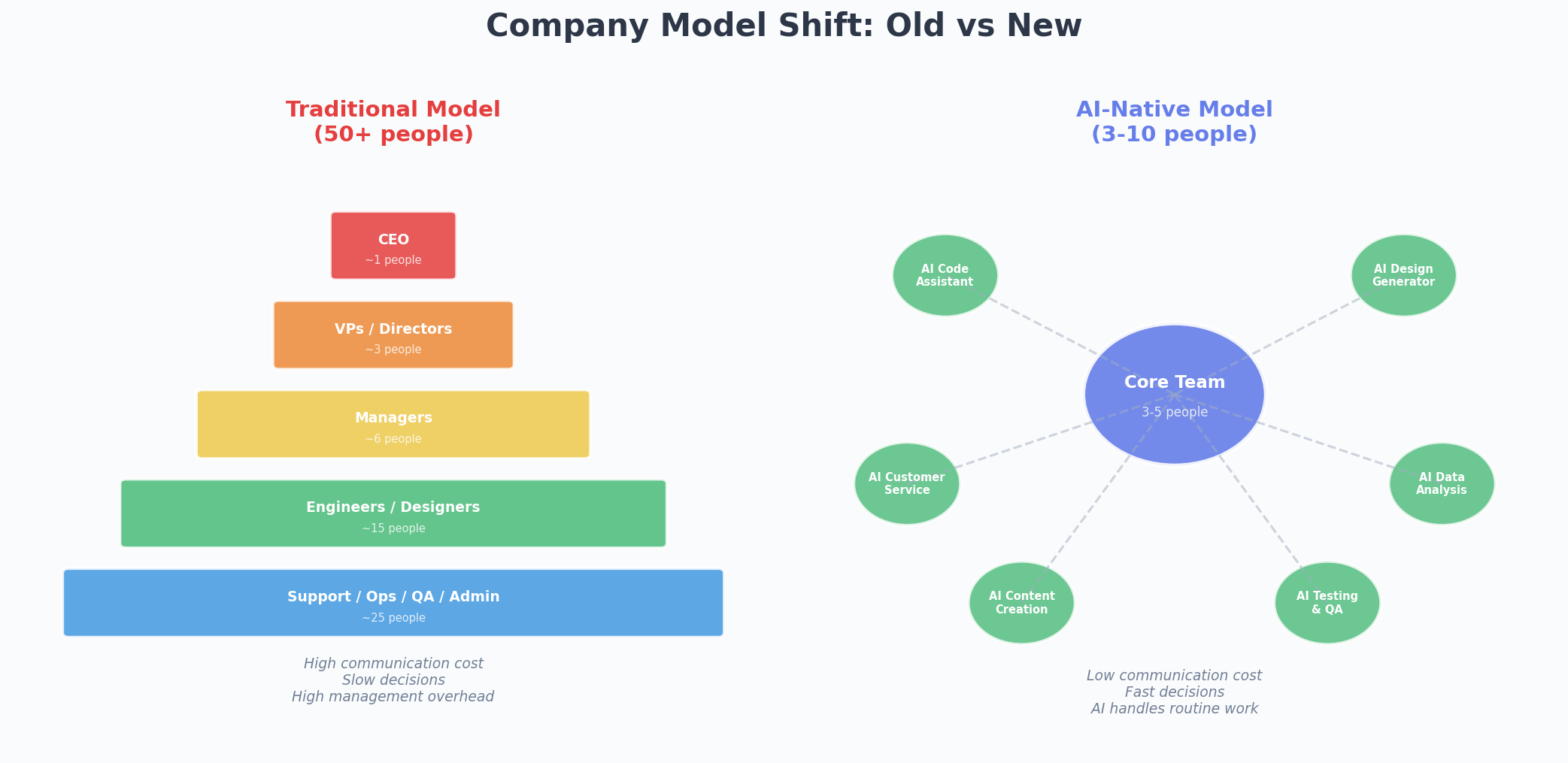
The traditional company model is built on a basic assumption: doing more requires more people.
To develop a product, you need product managers, designers, frontend engineers, backend engineers, QA engineers, DevOps. To market it, you need marketing, operations, customer service. To manage all these people, you need project managers, HR, admin.
As headcount grows, communication costs explode. A five-person team has 10 communication lines. Ten people: 45. Fifty people: 1,225. That’s why large companies are inefficient — it’s not that people are bad, it’s that communication complexity grows exponentially with headcount.
So you need hierarchies, processes, meetings, documents, approvals. These things don’t create value themselves, but without them, large organizations spiral out of control. Management overhead becomes a massive hidden tax.
The essence of the old model: trading management costs for scale effects.
This made sense in the industrial age. Assembly lines needed workers, workers needed management. But in the information age, especially the AI age, this equation is breaking down.
What AI Changes
AI does one thing: it turns work that required “one person” into work that requires “one person for one hour.”
Writing marketing copy used to take a copywriter a full day. Now you explain the requirements to AI, get a draft in ten minutes, spend twenty minutes polishing.
Creating a product prototype used to take a designer several days. Now you generate interfaces with AI, tweak them yourself, done in half a day.
Writing a backend API used to take an engineer half a day plus debugging. Now AI writes it, you review, and within an hour tests are passing.
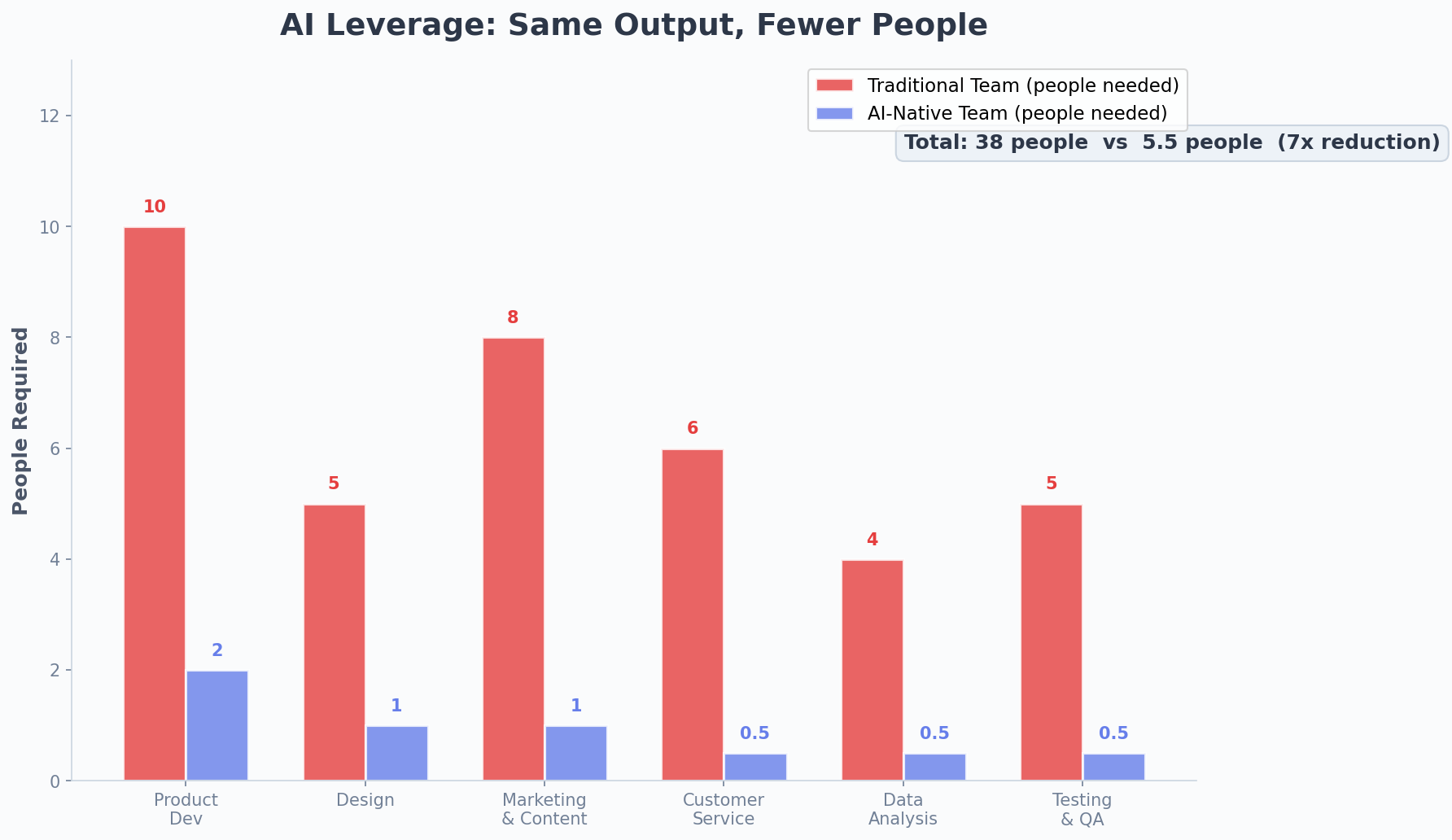
The efficiency gain in individual steps isn’t the point. The point is: when every step speeds up 5-10x, one person can cover the work scope of several people.
This doesn’t mean AI replaces people. It means AI dramatically expands one person’s capability boundary. A product-minded engineer, plus AI, can simultaneously play the roles of product manager, designer, frontend, backend, QA, and copywriter. Not 100% in each role, but 70-80% is enough to ship a product.
New Model One: The Super Individual
The first new model is the Super Individual — one person is an entire company.
This isn’t a new concept; freelancers have always existed. But AI-era super individuals are different. Traditional freelancers could usually only do one thing — designers designed, programmers coded. Now one person can go full-stack: from idea to product to launch to operations, handling the entire chain.
I’ve seen a solo developer build a SaaS product generating tens of thousands of dollars monthly. His “team”: himself + ChatGPT + Cursor + Midjourney + a few automation tools. Customer service handled by AI chatbot, finances automated through Stripe, deployment one-click via Vercel.
The advantages are obvious:
- Zero communication cost. All decisions happen in one brain. No meetings, no alignment, no waiting for approvals.
- Maximum flexibility. Want to add a feature today? It’s live this afternoon. Want to pivot? Done tomorrow.
- Extremely high margins. No labor costs means revenue nearly equals profit.
There are limitations, of course: one person’s energy is finite, limiting scale. But the definition of “too big for one person” keeps expanding — things impossible for one person before are now feasible.
New Model Two: AI-Native Small Teams
The second model is the AI-Native small team — three to ten people producing what previously required fifty.
The defining characteristic: every person is a full-stack talent, with AI as everyone’s co-pilot.
Traditional teams divide by function: product group, design group, dev group, QA group. AI-Native teams divide by business module: each person owns a complete module from requirements to launch. AI fills in their skill gaps.
Patterns I’ve observed:
Very few meetings. Since everyone can make independent decisions, frequent alignment isn’t needed. Async communication dominates, documentation-driven.
No dedicated managers. The team is small enough that “management” isn’t needed. Everyone is a maker; nobody is just a manager.
AI tools deeply integrated into workflows. Not occasional ChatGPT use, but AI permeating every step — Cursor for coding, AI for design generation, AI-assisted documentation, AI for data analysis.
Hiring criteria changed. It’s no longer about how many programming languages you know or frameworks you’ve used. It’s: can you independently take something from start to finish? Can you efficiently use AI tools? Do you have product sense?
Many emerging AI startups exemplify this model. You’ll notice that companies producing amazing products often have surprisingly tiny teams.
New Model Three: Dynamic Networks
The third model is more radical: a company is no longer a fixed organization but a dynamic collaboration network.
The core team might be just two or three people, responsible for product direction and core technology. Everything else is accomplished through combinations of freelancers, contractors, and AI Agents. Need a marketing campaign? Partner with a freelance marketing expert for two weeks. Need complex data analysis? Let an AI Agent run it, human reviews results.
The essence: converting fixed costs to variable costs.
Traditional companies pay full-time employees regardless of workload. In the dynamic network model, you only pay when needed. AI further reduces friction — the costs of finding contractors, coordinating, communicating, and reviewing used to be high. Now AI handles many intermediate steps.
Impact on Traditional Large Companies
What do these new models mean for traditional large companies?
First, competitors multiply. Products that only large companies could build before, small teams can now build too. And small teams are faster, more flexible, more willing to take risks. Features that take a large company a year might take a small team two months.
Second, talent drain accelerates. The best talent realizes they can create enormous value with just themselves and AI. Why stay at a big company attending meetings, writing weekly reports, waiting for approvals? The super individual and small team models are increasingly attractive to top talent.
Third, organizational bloat costs more. Previously, large companies being slightly inefficient was fine because competitors were similar. Not anymore — your competitor might be a three-person team with 10x your decision speed and 5x your iteration speed.
This doesn’t mean large companies will disappear. They have their advantages: brand, distribution, data, capital, compliance capabilities. But large companies need to transform — either get smaller, get faster, or do things small companies can’t.
New Competitive Moats
Under new models, competitive moats are shifting.
Old moats: More people, more money, deeper tech accumulation. You have a thousand engineers; others can’t catch up.
New moats:
- Data flywheels. Whoever’s product has more users, generates more data, trains better models — that’s the moat.
- AI utilization efficiency. Same AI, but some achieve 10x efficiency gains while others only get 2x. The difference lies in understanding AI’s capability boundaries and workflow design.
- Speed. In the AI era, speed is a moat. Ship two weeks before competitors and you capture users and feedback data first.
- Taste and judgment. When AI reduces execution costs to near zero, what determines success is “what to build” not “how to build it.” Product taste and strategic judgment matter more than ever.
- Trust and brand. AI can help you build products but can’t build trust. Users choosing you over competitors increasingly depends on brand and reputation.
What Future Companies Look Like
Extrapolating these trends, future companies might look like this:
Most companies will get smaller. Not because they’re doing less, but because the same work requires fewer people. A 50-person company might shrink to 15, with equal or higher output.
Organizational structures will flatten. Middle management will compress. When everyone can make independent decisions and AI handles coordination, hierarchies lose their purpose.
The boundary between full-time employees and external collaborators will blur. Core team + dynamic external network becomes the norm.
AI will become “employees.” Not metaphorically — literally. Companies will have AI Agents handling customer service, data analysis, content production, code review. These Agents will have their own “desks” (runtime environments), “permissions” (API access), “performance reviews” (quality monitoring).
Startup barriers will drop dramatically. A person with an idea, without fundraising or hiring, can build a competitive product. This means startup volume will explode, but success standards will also rise — because competition intensifies.
Final Thoughts
Every technological revolution reshapes organizational forms.
The Industrial Revolution spawned factories and assembly lines. The Information Revolution spawned internet companies and remote work. The AI Revolution is spawning new company models — smaller, faster, more flexible, with AI deeply embedded in every function.
For individuals, this is both opportunity and challenge. The opportunity: you no longer need a large team to do big things. The challenge: if you don’t learn to collaborate with AI, your competitiveness will decline rapidly.
My prediction: in the next five years, “knowing how to use AI” will go from a bonus to a baseline skill, just like “knowing how to use a computer.” It’s not a question of whether you’ll learn, but when you’ll start.
And those who embrace new models earliest will capture the biggest dividends.
As with every technological revolution — the early movers feast, the followers get scraps, and the oblivious foot the bill.
 微信
微信- 支付宝