
How AI Will Transform Society
Standing at the Crossroads
Every few decades, human society encounters a crossroads.
When the steam engine arrived, some said it would liberate human hands. Others said it would reduce workers to slaves of machines. Both predictions came true — the Industrial Revolution created unprecedented prosperity and also produced sweatshops and child labor.
When the internet arrived, some said it would enable free information flow and eliminate information asymmetry. Others said it would create filter bubbles and digital divides. Both predictions also came true.
Now it’s AI’s turn.
The divide between optimists and pessimists about where AI will take society may be the most extreme in the history of technological revolutions. Optimists say AI will usher in a golden age of human civilization. Pessimists say AI might be humanity’s last invention.
Neither side is being alarmist. That’s what makes it so unsettling.
Today I want to lay both perspectives out honestly — not to pick sides, but to see clearly what we’re actually facing.
The Optimistic Case: The Beautiful Possibilities
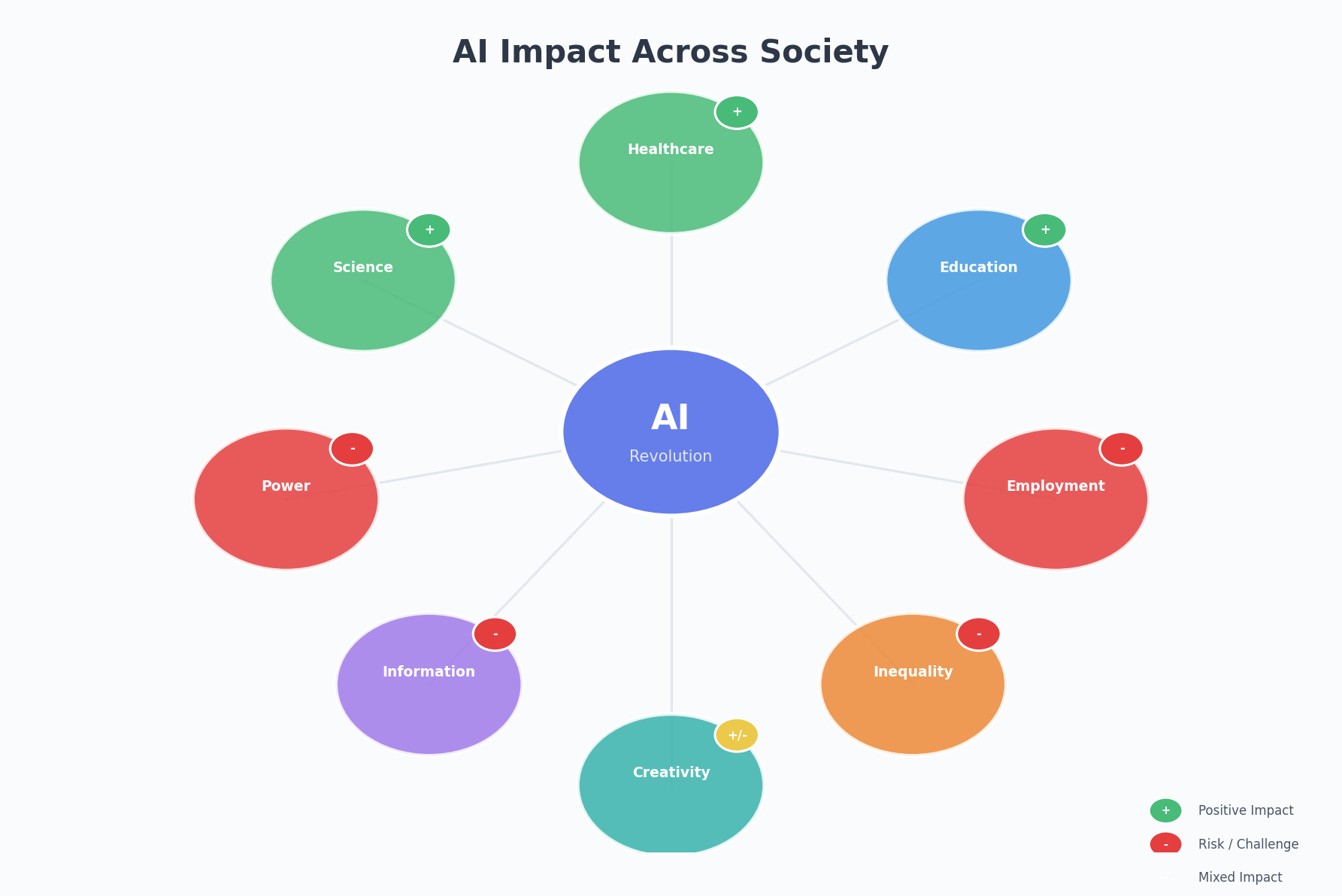
Healthcare: World-Class Medicine for Everyone
How many of the world’s best doctors are there? A few thousand? Tens of thousands? Whatever the number, it’s certainly not enough for 8 billion people.
AI is changing this equation. AlphaFold solved the protein folding problem, meaning drug development speed could improve by an order of magnitude. AI-assisted diagnosis has already matched or exceeded specialist physicians in certain areas (like skin cancer screening and retinal disease detection).
Imagine this future: you feel unwell, and AI generates a personalized diagnosis and treatment plan based on your genomic data, lifestyle habits, and medical history. No waiting three hours for a three-minute consultation. No delayed treatment due to uneven medical resource distribution.
This isn’t science fiction. Many of these technologies already work in labs — what’s missing is clinical validation and regulatory approval.
If AI can bring the medical standard currently available only to the few to all 8 billion people globally, this could be the greatest welfare improvement in human history.
Education: A Private Tutor for Every Child
What’s the essence of education? An experienced person teaching knowledge in the most suitable way based on each student’s specific situation.
The problem is, one teacher facing forty or fifty students simply can’t personalize instruction. That’s not the teacher’s fault — it’s a resource constraint.
AI can break this constraint. An AI tutor can:
- Precisely identify each student’s knowledge gaps
- Adjust teaching methods to match learning styles
- Answer questions with infinite patience
- Be available 24/7
- Cover everything from elementary math to quantum physics
What does this mean? A child in a remote village could theoretically access the same quality education as a student at an elite school. Educational equity might, for the first time, move from slogan to reality.
Productivity: Democratization of Creativity
As I discussed in my previous article, AI is making it possible for “one person to outperform a team.” The deeper implication: creativity is being democratized.
Previously, turning an idea into a product required capital, a team, and technical skills. Most people had ideas but lacked resources to realize them. Now, AI has lowered the barrier to implementation to unprecedented levels.
Someone who never learned programming can build an app with AI. Someone who never learned to draw can generate beautiful illustrations. Someone who never studied music can compose a song.
This doesn’t mean professional skills don’t matter anymore. It means more people get to participate in creation, rather than being limited to consumption. When the number of creators goes from millions to billions, the pace of human innovation will undergo a qualitative leap.
Science: Accelerating Fundamental Research
AI’s potential in scientific research may be the most underestimated.
Mathematical proofs, materials discovery, climate simulation, gene editing… breakthroughs in these fields often require processing massive data and exploring enormous search spaces. Human scientists’ intuition matters, but in certain dimensions, AI’s computational power is overwhelming.
DeepMind used AI to discover new mathematical theorems. AI has found materials in materials science that humans never conceived of. These aren’t replacing scientists — they’re equipping scientists with telescopes and microscopes, letting them see what was previously invisible.
If AI can help humanity achieve breakthroughs in controlled nuclear fusion, cancer treatment, and climate change, its contribution to human civilization will be immeasurable.
The Pessimistic Case: The Risks
Employment: Mass Unemployment Isn’t Alarmist
Every technological revolution eliminates some jobs while creating new ones. The steam engine eliminated hand weavers but created factory workers. The internet eliminated many middlemen but created programmers and content creators.
Optimists say AI will be the same — old jobs disappear, new ones emerge, total employment stays the same or even grows.
But this time might truly be different.
Previous technological revolutions replaced physical labor or simple repetitive cognitive work. AI replaces cognitive labor — writing, analysis, programming, design, translation, customer service, legal consulting… These are the core skills of the middle class.
And the replacement speed may far exceed the creation speed of new jobs. The Industrial Revolution took decades to complete its transition, giving society enough time to adapt. AI’s penetration speed is measured in years, even months.
More critically: newly created jobs may require higher skill thresholds. Not every displaced customer service rep can retrain as an AI trainer. Not every displaced junior programmer can upgrade to an AI systems architect.
If large populations lose their jobs in a short time without adequate social safety nets, social upheaval is almost inevitable.
Inequality: The Tech Divide Deepens Wealth Gaps
AI’s benefits aren’t evenly distributed.
Who benefits from AI first? Those with capital to purchase AI tools, education to understand AI capabilities, and infrastructure to support AI operations — both people and nations.
A Silicon Valley engineer uses Cursor to code, boosting productivity 5x. A programmer in a developing country might not even have stable internet.
A large corporation uses AI to optimize its supply chain, doubling profits. A small workshop owner might not even know what AI is.
The history of technological revolutions tells us: new technology almost always exacerbates inequality in the short term. Only after technology becomes sufficiently widespread and costs drop low enough do benefits spread to broader populations. But before that, the gap between early adopters and laggards widens dramatically.
The same applies at the national level. The gap between countries mastering core AI technology (primarily the US and China) and others could be larger than during the internet era.
Information: A World Where Truth Is Indistinguishable
Deepfakes are old news. But as AI generation capabilities improve, the problem will become far more severe.
When AI can generate indistinguishable fake videos, audio, and text, how do we determine what’s real? When anyone can mass-produce disinformation with AI, will the “consensus” foundation that democratic societies depend on collapse?
This isn’t a technical problem — it’s a social one. Technically you can build AI detection to identify fakes, but it’s an arms race you can never win — generation technology always outpaces detection.
The deeper issue: when people no longer trust what they see and hear, the foundation of social trust erodes. And trust is the prerequisite for all social cooperation.
Power Concentration: A Few Control AI Infrastructure
Training a frontier large model costs hundreds of millions to billions of dollars. This means only a handful of companies can do it.
OpenAI, Google, Anthropic, Meta… the companies capable of training top-tier models can be counted on one hand. These companies control the most critical infrastructure of the AI era.
This concentration is more extreme than the internet era. During the internet era, though Google and Facebook were huge, anyone could build a website. In the AI era, you can use others’ APIs, but you can’t train your own foundation model.
When a few companies control AI’s “power plants,” their influence on society will exceed many national governments. Their values, biases, and commercial interests will permeate every corner of society through AI.
Existential Risk: The Possibility of Loss of Control
This is the most extreme pessimistic view, but it’s not proposed by science fiction writers — it comes from AI’s most elite researchers.
Hinton (the godfather of deep learning) left Google specifically to warn about AI risks. Yoshua Bengio (another Turing Award winner) signed an open letter calling for a pause in AI development. OpenAI itself established a “superalignment” team (though the team later disbanded, which itself is telling).
They’re not worried about current AI, but about potential future superintelligence. If an AI system’s intelligence far exceeds humanity’s, and we can’t ensure its goals align with human interests, the consequences could be catastrophic.
How large is this risk? Nobody knows. Maybe 1%, maybe 10%, maybe 0.01%. But when the stakes are all of human civilization, even a small probability deserves serious attention.
The Overlooked Middle Ground
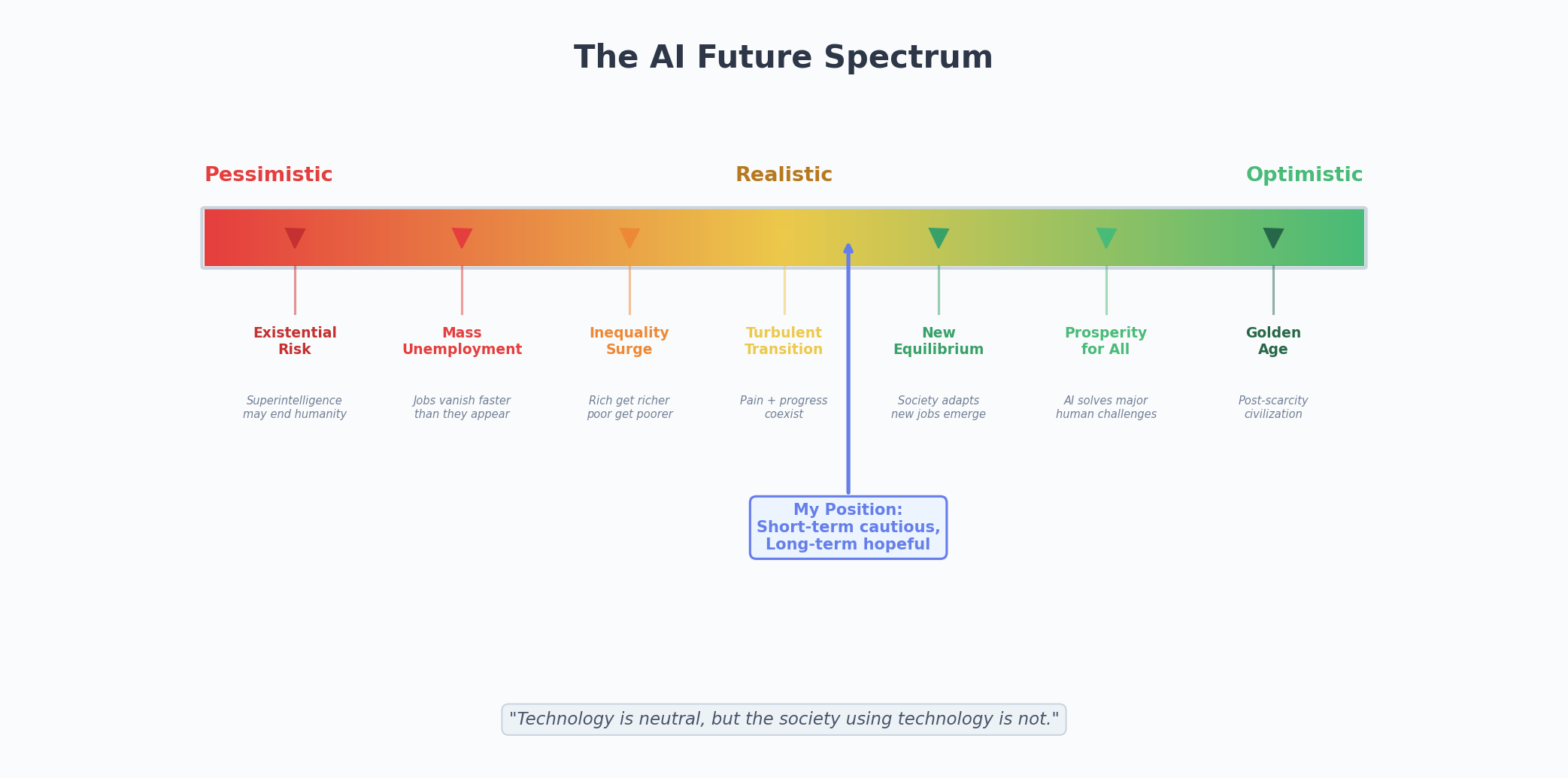
Most discussions about AI’s future are either extremely optimistic or extremely pessimistic. But reality usually falls in between.
The history of technological revolutions tells us: good and bad typically happen simultaneously.
The Industrial Revolution brought prosperity and also pollution and exploitation. The internet brought information freedom and also privacy invasion and the attention economy. AI will most likely be the same — simultaneously bringing enormous benefits and enormous problems.
The key isn’t whether AI itself is good or bad, but:
How we choose to use it.
The same AI technology can be used for personalized education or personalized manipulation. To accelerate drug development or to design bioweapons. To help people with disabilities or for mass surveillance.
Technology is neutral, but the society using technology is not. Institutions, laws, culture, values — this “soft infrastructure” determines where technology ultimately leads.
My Assessment
After discussing all this, here’s my personal take.
Short-term (3-5 years), I lean pessimistic. Employment shocks will come faster and harder than most people expect. Society’s adaptation speed can’t keep up with technology’s pace of change. There will be a period of turbulence.
Medium-term (5-15 years), I’m cautiously optimistic. New work paradigms will gradually take shape, social systems will begin adapting. AI’s positive impact in healthcare, education, and research will become increasingly apparent. But inequality will remain a persistent challenge.
Long-term (15+ years), I’m uncertain. This depends on too many variables we can’t currently predict — AI’s development speed, degree of international cooperation, evolution of social systems, whether black swan events occur.
But one thing I’m fairly certain about: passive waiting is the worst strategy.
Whether you’re optimistic or pessimistic, the most rational approach is: actively understand AI, learn to use AI, while also paying attention to the social problems AI creates and pushing for responsible AI development.
Final Thoughts
I’m reminded of an old story.
When cars were first invented, Britain passed the “Red Flag Act” — requiring every car to be preceded by a person walking with a red flag, with the car’s speed not exceeding walking pace.
The law’s intention was to protect pedestrian safety, and the motivation was sound. But the result was that Britain’s automotive industry fell far behind Germany and America.
Excessive fear is as dangerous as blind optimism.
AI will profoundly transform society — there’s no doubt about that. The transformation will involve growing pains, risks, winners, and losers. But history tells us that the general direction of technological revolution is irreversible — you can influence its trajectory, but you can’t stop its arrival.
Rather than debating whether AI is angel or demon, perhaps we should ask: what can we do to amplify the angel and diminish the demon?
The answer to that question isn’t in AI’s hands. It’s in ours.
 微信
微信- 支付宝